Rising in the Ranks

Yesterday, the 2014 Shanghai Rankings, the influential global ranking of universities by Jiao Tong University in China, were released.  Singapore continued its upward rise as its two leading universities saw spectacular gains. The National University of Singapore (NUS) fell just short of breaking into the top 100 as it rose from 134 to 111, while Nanyang Technological University (NTU) now ranks 190th in the world, up from 269.

Singapore’s continued success comes at a time when the higher education landscape in Singapore is changing.  In order to meet the goal of raising the proportion of the young population with a university degree to 40% by 2020, which is comparable to the average in the OECD and up from 27% just two years ago, the government established the 5th autonomous (national) university, Singapore Institute of Technology last year and opened full time degree programs at another. The degrees at these institutions are mostly in applied fields and particularly geared to offer Polytechnic graduates the chance to top up their 3 year diplomas to bachelor’s degrees.

Raising the skills of the population is essential for Singapore to maintain its globally competitive position. But the always pragmatic Singaporean government seems to be signaling a shift in where it sees higher education going; it is now stressing that key skills need not necessarily come from a university degree.

Tomorrow’s National Day Rally (NDR), which is the annual occasion for the Prime Minister to lay out the policy priorities for the coming year, will take place at the Institute for Technical Education, a vocational and technical training institution, rather than at NUS where it is traditionally held. PM Lee Hsien Loong reportedly will focus on the importance of attaining skills though programs that combine study and work, not through a solely academic track.

Convincing parents that their children’s success in ultra-competitive Singapore does not require a degree will be a bit of an uphill battle as politicians recognize.  In advance of the NDR speech, Irene Ng, a Member of Parliament for the ruling party who sits on the Education Committee in Parliament is quoted in the Straits Times as saying: “a university degree is not a must-have to advance in life and do well. This will require quite a cultural shift in a society which has traditionally placed top emphasis on academic qualifications.”

But the alternative – too many degree holders for jobs that do not exist and a shortage of people with in-demand technical skills – would potentially slow the economy and create potentially greater public dissatisfaction than fewer degree places in universities.

As Singapore’s top universities rise in the global rankings, the country is also trying to raise the life chances of average citizens by expanding pathways beyond universities.
 

Not yours for the taking

(Op-ed published by Today, Aug. 1, 2014)

By Trisha Craig

Plagiarism, or taking other people’s words and ideas and passing them off as one’s own, has burst into the news in the past week. While many universities around the world consider it a silent epidemic, the very public transgressions of Mr Benny Johnson, a high-profile editor of popular Internet site Buzzfeed, and United States Senator John Walsh have cast a bright light on the issue of the proper attribution of source material and brought it into the open.

As unfortunate as these instances are, they act as a reminder that plagiarism can have severe and career-damaging consequences. In the case of the editor, his bosses fired him after finding more than 40 instances of plagiarism in his recent posts, while revelations that the Senator copied parts of his 2007 Master’s thesis at the prestigious US Army War College has put both his degree and re-election into jeopardy.

In higher education, faculty and administrators grapple with the issue of plagiarism which, while less headline grabbing, is commonly viewed as an endemic and growing problem on college campuses across the globe. Intellectual fraud does not occur only in the classroom — top universities now routinely check their admissions essays for pilfered paragraphs.

Many explanations for the rise in plagiarism are offered. They suggest a downward spiral that is hard to stop: Compared with the past, there is less social stigma, punishments are less harsh, detection is more difficult and pressures on students to excel are greater. In short, the risk and reward calculus has shifted and, as more people cheat and roughly get away with it, the numbers continue to rise. Continue reading …

The Rise of the Asian Univer-City

Image

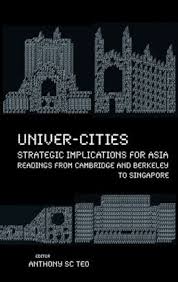
Yesterday, Nanyang Technological University (NTU), Singapore’s number two university and one of the top 50 globally, hosted the Univer-Cities conference.  This presented the new volume, Univer-Cities: Strategic Implications for Asia. Readings from Cambridge and Berkeley to Singapore, edited by Anthony SC Teo and published by World Scientific, the first product of a long term conversation among scholars and university planners from those cities.

The central question the project considers is how universities in the future can engage surrounding communities, expand local industry and foster links that will make both campus and community vibrant places. For Asia, where higher education is exploding and new universities are springing up across the continent, Anglo-American examples of univer-cities like Cambridge (UK) and Berkeley offer imaginable futures of dynamic new urban spaces.

Interestingly, given its prominence in most ‘future of higher education’ conversations these days, there was an absence of much discussion at the conference of MOOCs. Not that the researchers are unaware of them – indeed, panelists from across the region acknowledged that learning in universities is changing, will continue to do so and that electronically delivered content will play a permanent role in curricula.  But their insistence on the role that actual universities play as ‘place-making’ institutions highlights a development model for Asia that is losing importance in many parts of the US where deep budget cuts may harm the ability of universities to act as engines of regional growth.

One hurdle that a number of panelists mentioned was the difficulty not of getting the city and university to talk to each other but getting neighboring universities to talk to each other. Academic leaders in Singapore admitted that the university space is inhabited by institutions that see each other as rivals and competitors, not potential collaborators. Here, the other Cambridge (MA) could provide a model where multiple great universities run joint programs, centers and institutes (i.e. NBER, the Broad Institute, EdX, etc.) that enhance what they do individually.

Universities dig deep

On the same day that Harvard has announced it will be asking alums and others to dig deep to help them raise $6.5 billion in a new capital campaign, the New York Times reports that in Singapore, universities may really be about to dig deep.  In a country where the joke is the national bird is the crane, finding ways to build on the very limited land is always a challenge.  By exploring the possibility of going underground to build classrooms, gymnasiums, libraries and meeting space, the National and Nanyang Technological universities may make the most of their campuses where expanding out is not feasible.

Ultimately, what will matter more than spectacular feats of engineering to go underground on this island, is how and whether the campuses are able to develop a dialogue with the urban culture where they are located.  If Singapore is to follow the path of other global urban educational hubs where development is driven at least in large part by great universities and the links with the surrounding communities (think the two Cambridges, Berkeley, etc.) it will need to find ways for them to communicate well.

As university planners consider the merits of expanding in a subterranean direction, they should also consider how those areas can be designed to enhance the vibrancy of connections with the local urban space.