World insight: Banging the drum for liberal arts in East Asia

Countries like Singapore are turning to broad-based education just as the US turns away from it, says Trisha Craig

Published by Times Higher Education, February 19, 2016

There is some irony in the fact that at the very moment that the liberal arts model of education is under attack in the West as impractical and irrelevant, it is being embraced in Asia. Places that routinely post the top international test scores in maths and science – the likes of Singapore, Hong Kong, Japan and South Korea as well as India and China – have moved to create new undergraduate liberal arts programmes or colleges, adopting the broad-based education that defines some of the US’ finest institutions. Continue reading …

The benefits of international experience: Europe’s lessons for Asia

To coincide with International Education Week, the US State Department’s reminder of the value of work and study abroad, I wrote this piece for Today.  It looks at a recent EU study of the Erasmus program, the student mobility scheme that has helped hundreds of thousands of young Europeans study and work elsewhere in the European Union, and applies the lessons to Asia.  In Singapore, where policy makers worry that the mismatch of labor market needs with the skills of graduates may raise unemployment as it has elsewhere in the world, the ASPIRE commission has urged that more work experience be integrated into study at the tertiary level.  Using the Erasmus impact study results, I suggest that the benefits of international study or work experience for students in terms of employability should not be overlooked.  Continue reading

Rising in the Ranks

Yesterday, the 2014 Shanghai Rankings, the influential global ranking of universities by Jiao Tong University in China, were released.  Singapore continued its upward rise as its two leading universities saw spectacular gains. The National University of Singapore (NUS) fell just short of breaking into the top 100 as it rose from 134 to 111, while Nanyang Technological University (NTU) now ranks 190th in the world, up from 269.

Singapore’s continued success comes at a time when the higher education landscape in Singapore is changing.  In order to meet the goal of raising the proportion of the young population with a university degree to 40% by 2020, which is comparable to the average in the OECD and up from 27% just two years ago, the government established the 5th autonomous (national) university, Singapore Institute of Technology last year and opened full time degree programs at another. The degrees at these institutions are mostly in applied fields and particularly geared to offer Polytechnic graduates the chance to top up their 3 year diplomas to bachelor’s degrees.

Raising the skills of the population is essential for Singapore to maintain its globally competitive position. But the always pragmatic Singaporean government seems to be signaling a shift in where it sees higher education going; it is now stressing that key skills need not necessarily come from a university degree.

Tomorrow’s National Day Rally (NDR), which is the annual occasion for the Prime Minister to lay out the policy priorities for the coming year, will take place at the Institute for Technical Education, a vocational and technical training institution, rather than at NUS where it is traditionally held. PM Lee Hsien Loong reportedly will focus on the importance of attaining skills though programs that combine study and work, not through a solely academic track.

Convincing parents that their children’s success in ultra-competitive Singapore does not require a degree will be a bit of an uphill battle as politicians recognize.  In advance of the NDR speech, Irene Ng, a Member of Parliament for the ruling party who sits on the Education Committee in Parliament is quoted in the Straits Times as saying: “a university degree is not a must-have to advance in life and do well. This will require quite a cultural shift in a society which has traditionally placed top emphasis on academic qualifications.”

But the alternative – too many degree holders for jobs that do not exist and a shortage of people with in-demand technical skills – would potentially slow the economy and create potentially greater public dissatisfaction than fewer degree places in universities.

As Singapore’s top universities rise in the global rankings, the country is also trying to raise the life chances of average citizens by expanding pathways beyond universities.


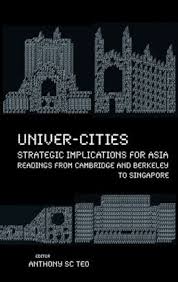
The Rise of the Asian Univer-City

Image

Yesterday, Nanyang Technological University (NTU), Singapore’s number two university and one of the top 50 globally, hosted the Univer-Cities conference.  This presented the new volume, Univer-Cities: Strategic Implications for Asia. Readings from Cambridge and Berkeley to Singapore, edited by Anthony SC Teo and published by World Scientific, the first product of a long term conversation among scholars and university planners from those cities.

The central question the project considers is how universities in the future can engage surrounding communities, expand local industry and foster links that will make both campus and community vibrant places. For Asia, where higher education is exploding and new universities are springing up across the continent, Anglo-American examples of univer-cities like Cambridge (UK) and Berkeley offer imaginable futures of dynamic new urban spaces.

Interestingly, given its prominence in most ‘future of higher education’ conversations these days, there was an absence of much discussion at the conference of MOOCs. Not that the researchers are unaware of them – indeed, panelists from across the region acknowledged that learning in universities is changing, will continue to do so and that electronically delivered content will play a permanent role in curricula.  But their insistence on the role that actual universities play as ‘place-making’ institutions highlights a development model for Asia that is losing importance in many parts of the US where deep budget cuts may harm the ability of universities to act as engines of regional growth.

One hurdle that a number of panelists mentioned was the difficulty not of getting the city and university to talk to each other but getting neighboring universities to talk to each other. Academic leaders in Singapore admitted that the university space is inhabited by institutions that see each other as rivals and competitors, not potential collaborators. Here, the other Cambridge (MA) could provide a model where multiple great universities run joint programs, centers and institutes (i.e. NBER, the Broad Institute, EdX, etc.) that enhance what they do individually.

What’s a Humanities PhD to Do?

It has been a big week for lamentations and cautionary tales about how making the wrong decision early in your academic career will lead to unrelenting unhappiness and a diminished life.  First, Susan Patton told undergraduate women at Princeton to snag a husband before they graduate or they risked a life of humiliation and despair by potentially ending up with a mate from a no-name school.

That got a lot of people worked up but for academics, the hot-button article was Rebecca Schuman’s, a visiting assistant professor of German Studies at Ohio State University, piece in Slate, “Thesis Hatement.” She practically begged people not to think of getting a PhD in the humanities, and like an ivory tower Taylor Swift, cautioned them that they will never, ever, ever find anything remotely like a fulfilling, stable, decently paid, benefitted job as an academic and will turn into underemployed, bitter, basket cases. It was the most read and most shared piece on the site for much of the week.

Now, warning people off grad school is not new; just wander over to the Chronicle of Higher Education’s site, where it has been a sort of self-flagellating genre for academics for some time.

But there are some elements to the current woes that are worth mentioning.  First, there are some corrections going on in this oversupplied market: graduate programs, especially in the humanities, are shrinking in the US. In part, this has to do with ongoing budget cuts at both state and private institutions as well as a decision on the part of departments to curtail the number of graduates they produce given the abysmal state of the job market.  The decline in foreign student applications to graduate programs also seems to be affecting humanities and the softer social sciences. Continue reading

JC or Poly? An education in options is needed

A student from Ngee Ann Secondary School looking at her "O" level results on Jan 9, 2012. Photo: Wee Teck Hian.

A student from Ngee Ann Secondary School looking at her “O” level results on Jan 9, 2012. Photo: Wee Teck Hian.

Op-ed published in Today, Jan. 24, 2013

By Trisha Craig

University degrees are many things: Markers of academic achievement, recognition of subject mastery, status symbols, signals to the labour market, luxury goods as well as credentials.

In Singapore, as elsewhere, obtaining a degree is evermore viewed as essential for attaining economic success and upward mobility.

Not only does post-secondary education produce a higher return for every year of additional schooling than lower levels, but in the last decade, the returns to university education were growing faster than for other types of education as the shift to a more knowledge-intensive economy became more pronounced in Singapore.

Put another way, the share of national income, not surprisingly, accrues disproportionately to those who hold university degrees.

A 2008 study by National University of Singapore professor Ishita Dhamani showed that while degree holders made up only 17 per cent of the population, they took home approximately a third of the income.

Against this backdrop, small wonder that the demand for higher education is growing.

The Government is doing an admirable job of attempting to expand the number of available university slots for its citizens, with an eye not just to numbers but to ensuring places in fields where there is market demand for graduates.

Just in the past decade, the expansion has been enormous: Compared with 2002, the intake for full-time students at university has grown by 40 per cent while at the polytechnics, the increase has been almost 50 per cent.

By 2020, the Government’s goal is to ensure that 40 per cent of the age cohort has the opportunity to attend university in Singapore. Continue reading …

When will Asia join the MOOC party?

The hottest concept in higher education right now is MOOCs, or Massive Online Open Courses. This has been a while in the making. MIT’s decision a decade ago to create OpenCourseWare that put much of its course material online was a startling move but one that ultimately changed the way people learn in important ways.   It paved the way for Stanford’s recent experiment with putting some of its courses online in their entirety for free (though not for Stanford credit), which drew hundreds of thousands of students worldwide, showing that the technology to deliver courses to mass audiences had finally come of age.

In a remarkably short period of time, this had led to the creation of several initiatives and consortia by some of the world’s leading universities and faculty members: Coursera is a company founded by Stanford faculty members and has signed up several dozen top universities across the globe to offer online classes, Ed-X is a joint venture between Harvard and MIT that has recently brought Berkeley and Texas on board, and Udacity, a for-profit spinoff of Stanford that focuses on computer science and engineering courses that are project-based.

What is also noteworthy is that at a time when many commentators are advancing a rise of the East, decline of the West narrative when it comes to higher education, the MOOC phenomena is, at least in terms of producers, almost entirely a phenomenon of elite North American institutions.  If you look at the list of Ed-X and Coursera’s partners you find that three quarters of the US universities in the Times Higher Education top 20 global rankings are already participating in one of these ventures, as are Canada’s two highest-ranked universities, UT and UBC. In contrast, none of the top 5 European universities has a MOOC tie-up.

So where is Asia in all this? For the moment, world-class institutions like University of Tokyo, National University of Singapore, University of Hong Kong, Peking University or Pohang University are conspicuously absent.  The one exception is HKUST, Hong Kong University of Science and Technology, and this is perhaps not a surprise. Its charismatic President, Tony Chan, who formerly taught at UCLA and Yale and was a director at NSF, calls HKUST the most American institution in Hong Kong.

Will leading Asian universities, or those in the rest of the world for that matter, embrace the concept? For now, there are some impediments. For some countries, language is a barrier to putting their offerings online. No matter how good their courses,  English is still the lingua franca of the elite world for online learning. Still, given the almost insatiable demand for higher education in Asia, Coursera’s co-founder has expressed the hope that HKUST will bring some of its courses on line in Chinese.

More serious though may be barriers stemming from university financing and culture. In this new educational gold rush, schools are making huge bets on an uncertain return.  Ed-X is reportedly a partnership with a $60 million investment; Coursera’s US partners are predominantly private institutions with large endowments while the public partners are mainly the flagship schools of the top state systems and have a median endowment of over $2 billion. Even without large endowments, there is no question that many Asian countries are willing to spend vast sums investing in their education systems.

But are they willing to invest for such an uncertain return? There is still no real business model, after all . It is hard to imagine many university presidents in the region who would have the boldness or sense of job security of the University of Pennsylvania’s President, Amy Gutmann, who said that the cost of bringing her institution’s courses online with Corsera amounted to “a rounding error” in her budget and was unconcerned about whether the initiative made money.

This is not the first time that US institutions have placed big bets on online education. Fathom and AllLearn were early forays by Ivy League institutions as the 21st Century turned that were spectacular failures.  These early pioneers lost boatloads of money on those ventures.  And while there are good reasons to think this time may be different (though how many times have we heard that phrase from everything from housing bubbles to tech stocks), the willingness of these same institutions to pick themselves up and dust themselves off and try again speaks to a certain form of American entrepreneurship that is often lacking in the rest of the world. That is the ability to fail and not be crushed by it. It may be that the rest of the world will take a wait and see approach and only if the business model is successful and clear will they jump in.

There is another reason the MOOCs might continue to be a primarily US or American-style phenomenon for some time, though, and that has to do with academic culture.  The idea of free and open access in terms of putting one’s intellectual property into the public domain is a relatively new development in the US and certainly not the norm everywhere. In many countries, something as simple as a request to see a syllabus is treated like asking for access to state secrets.  MOOCs also deal with the crush of students by relying on peer-to-peer interactions and a generally highly interactive style.  Such a teaching and learning style is still not widely practiced. Phil Altbach, the Director of Boston College’s Center for International Higher Education, has noted one of China’s biggest obstacles to university reform and improvement:  “the old tradition of rote learning and uncritical adherence to established texts, reinforced for millennia by the Confucian examination system, [which] is … detrimental to independent problem-solving and the new knowledge economy.” In such a system, the kinds of courses that fit well with the philosophy and structure of the MOOCs are unlikely to flourish. Alex Katsomitros points out that Coursera offerings that are highly interactive have failed to gain traction in Korea where students are not yet comfortable with that learning style.

So, from both a supply and demand side, MOOCs may lag for the time being in Asia.  Given the potential size of the market for higher education in the region, however, it is worth figuring out the best ways of breaking down some of the barriers to their adoption.