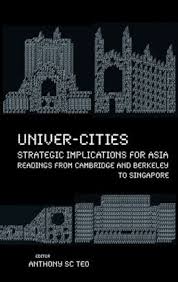
Yesterday, Nanyang Technological University (NTU), Singapore’s number two university and one of the top 50 globally, hosted the Univer-Cities conference. This presented the new volume, Univer-Cities: Strategic Implications for Asia. Readings from Cambridge and Berkeley to Singapore, edited by Anthony SC Teo and published by World Scientific, the first product of a long term conversation among scholars and university planners from those cities.
The central question the project considers is how universities in the future can engage surrounding communities, expand local industry and foster links that will make both campus and community vibrant places. For Asia, where higher education is exploding and new universities are springing up across the continent, Anglo-American examples of univer-cities like Cambridge (UK) and Berkeley offer imaginable futures of dynamic new urban spaces.
Interestingly, given its prominence in most ‘future of higher education’ conversations these days, there was an absence of much discussion at the conference of MOOCs. Not that the researchers are unaware of them – indeed, panelists from across the region acknowledged that learning in universities is changing, will continue to do so and that electronically delivered content will play a permanent role in curricula. But their insistence on the role that actual universities play as ‘place-making’ institutions highlights a development model for Asia that is losing importance in many parts of the US where deep budget cuts may harm the ability of universities to act as engines of regional growth.
One hurdle that a number of panelists mentioned was the difficulty not of getting the city and university to talk to each other but getting neighboring universities to talk to each other. Academic leaders in Singapore admitted that the university space is inhabited by institutions that see each other as rivals and competitors, not potential collaborators. Here, the other Cambridge (MA) could provide a model where multiple great universities run joint programs, centers and institutes (i.e. NBER, the Broad Institute, EdX, etc.) that enhance what they do individually.
 trishacraig