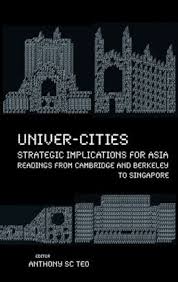
The Rise of the Asian Univer-City

Image

Yesterday, Nanyang Technological University (NTU), Singapore’s number two university and one of the top 50 globally, hosted the Univer-Cities conference.  This presented the new volume, Univer-Cities: Strategic Implications for Asia. Readings from Cambridge and Berkeley to Singapore, edited by Anthony SC Teo and published by World Scientific, the first product of a long term conversation among scholars and university planners from those cities.

The central question the project considers is how universities in the future can engage surrounding communities, expand local industry and foster links that will make both campus and community vibrant places. For Asia, where higher education is exploding and new universities are springing up across the continent, Anglo-American examples of univer-cities like Cambridge (UK) and Berkeley offer imaginable futures of dynamic new urban spaces.

Interestingly, given its prominence in most ‘future of higher education’ conversations these days, there was an absence of much discussion at the conference of MOOCs. Not that the researchers are unaware of them – indeed, panelists from across the region acknowledged that learning in universities is changing, will continue to do so and that electronically delivered content will play a permanent role in curricula.  But their insistence on the role that actual universities play as ‘place-making’ institutions highlights a development model for Asia that is losing importance in many parts of the US where deep budget cuts may harm the ability of universities to act as engines of regional growth.

One hurdle that a number of panelists mentioned was the difficulty not of getting the city and university to talk to each other but getting neighboring universities to talk to each other. Academic leaders in Singapore admitted that the university space is inhabited by institutions that see each other as rivals and competitors, not potential collaborators. Here, the other Cambridge (MA) could provide a model where multiple great universities run joint programs, centers and institutes (i.e. NBER, the Broad Institute, EdX, etc.) that enhance what they do individually.
Pre-school teachers: Leaving before they’ve even started

(Op-ed published by Today, Nov. 8, 2013)

By Trisha Craig

Over the past year, the Government has announced new measures and sources of funding to improve pre-school education in Singapore.

In addition to incentivising operators to hire more qualified teachers at better salaries, proposing schemes to keep pre-school affordable for low- and middle-income families and offering more scholarship money for prospective teachers, the creation of 16,000 more pre-school places is envisioned by 2017.

More places mean more choice for parents, which should be especially welcome news to working mums and dads if centres are nearer their homes or jobs. Yet, it also means, at least in the short run, that the shortage of teachers is likely to be an issue with which the sector will continue to grapple.

High teacher turnover at the pre-school level is a feature of Singapore and among the factors that account for its relatively low ranking globally in pre-school quality. Continue reading …

Universities dig deep

On the same day that Harvard has announced it will be asking alums and others to dig deep to help them raise $6.5 billion in a new capital campaign, the New York Times reports that in Singapore, universities may really be about to dig deep.  In a country where the joke is the national bird is the crane, finding ways to build on the very limited land is always a challenge.  By exploring the possibility of going underground to build classrooms, gymnasiums, libraries and meeting space, the National and Nanyang Technological universities may make the most of their campuses where expanding out is not feasible.

Ultimately, what will matter more than spectacular feats of engineering to go underground on this island, is how and whether the campuses are able to develop a dialogue with the urban culture where they are located.  If Singapore is to follow the path of other global urban educational hubs where development is driven at least in large part by great universities and the links with the surrounding communities (think the two Cambridges, Berkeley, etc.) it will need to find ways for them to communicate well.

As university planners consider the merits of expanding in a subterranean direction, they should also consider how those areas can be designed to enhance the vibrancy of connections with the local urban space.

High cost of low trust in pre-school education

(Op-ed published by The Straits Times on Sept. 6, 2013)

By Trisha Craig

IF PRE-SCHOOL were an Olympic event, Finland would have a lock on the gold.

Its early childhood education system consistently ranks at the top of international charts. And when you walk into typical Finnish classrooms, as I did last week, it is easy to see why.

On the metrics that matter with these global comparisons, Finland excels. The student-teacher ratios are low, meaning each teacher has fewer pupils to attend to. Teachers are well trained. This fosters warm, nurturing and intellectually engaging interactions.

Pre-school teachers in Finland are also well compensated and well respected, which means that centres face less of the disruptive high turnover that often plagues early education systems where teaching is less socially valued. Continue reading …

As childlessness becomes normative, what can policymakers do?

Op-ed published in Today, May 13, 2013

1305_AP_page_1

By Trisha Craig

This year, the celebration of Mother’s Day took place against the backdrop of a growing recognition that as a society, Singapore is moving to a situation where fewer women will become mothers and when they do, they will have fewer children.

So used to topping world rankings in matters of education, competitiveness or labour-market efficiency, Singapore also finds itself among the world leaders in low fertility and advanced maternal age at first birth. The fertility rate is hovering around a population-busting 1.2 children per woman and the average age at which a Singaporean woman has her first child is just shy of 30.

There is widespread public awareness of this trajectory and no shortage of discussion about the remedies for it: Make work-life balance easier to achieve by offering more paid leave to new parents, giving more subsidies and places for high-quality childcare, de-stigmatise part-time work, or prioritise and offer more attractive housing options, for starters.

It’s interesting to note that these potential policy options are being considered, or at least debated, in the context of a society where the value placed on being married and having children is high. This, though, is not unusual: In most developed countries where fertility has taken a nosedive as it has in Singapore, young people continue to see marriage and having children as an ideal.

In light of those stated preferences, it seems that getting the right mix of public policy to support those aspirations ought to be relatively simple. And yet, it is not.

Looking at the reasons why achieving this ideal is so hard is an important addition to the policy debate — because they suggest the real headwinds that policymakers face. Continue reading …

Embracing technology for the early years

Op-ed published in Today, April 22, 2013
By Trisha Craig and Zachary Walker

The Government’s revised kindergarten curriculum is a model for educating the young, with its emphasis on children’s holistic development, learning through play and ensuring that they begin to develop the 21st-century competencies that they will need as Singaporeans and global citizens.

As we prepare today’s learners for tomorrow’s world, it is important to acknowledge that some of the necessary skills include using technology. The curriculum framework notes a role for technology in the kindergarten classroom and that technology should be used in a developmentally appropriate manner and complement — not substitute — concrete activities like art and crafts or outdoor play.

However, the use of technology by young children is a fraught topic. Many view it as a particularly pernicious form of electronic babysitting, turning children into passive consumers of images and say that thus it has no place in educational settings. According to this view, the early childhood classroom is a peaceful haven from a hectic world that is connected 24/7.

However, precisely because technology is such an all-encompassing feature of modernity, to ignore it in educational settings misses the reality of the lives of most children, who are surrounded by it outside of school. Continue reading …

What’s a Humanities PhD to Do?

It has been a big week for lamentations and cautionary tales about how making the wrong decision early in your academic career will lead to unrelenting unhappiness and a diminished life.  First, Susan Patton told undergraduate women at Princeton to snag a husband before they graduate or they risked a life of humiliation and despair by potentially ending up with a mate from a no-name school.

That got a lot of people worked up but for academics, the hot-button article was Rebecca Schuman’s, a visiting assistant professor of German Studies at Ohio State University, piece in Slate, “Thesis Hatement.” She practically begged people not to think of getting a PhD in the humanities, and like an ivory tower Taylor Swift, cautioned them that they will never, ever, ever find anything remotely like a fulfilling, stable, decently paid, benefitted job as an academic and will turn into underemployed, bitter, basket cases. It was the most read and most shared piece on the site for much of the week.

Now, warning people off grad school is not new; just wander over to the Chronicle of Higher Education’s site, where it has been a sort of self-flagellating genre for academics for some time.

But there are some elements to the current woes that are worth mentioning.  First, there are some corrections going on in this oversupplied market: graduate programs, especially in the humanities, are shrinking in the US. In part, this has to do with ongoing budget cuts at both state and private institutions as well as a decision on the part of departments to curtail the number of graduates they produce given the abysmal state of the job market.  The decline in foreign student applications to graduate programs also seems to be affecting humanities and the softer social sciences. Continue reading

Let kids play, give teachers trust

Singaporean parents will support a focus on play in pre-school if convinced it will benefit their children later. TODAY file photo

Singaporean parents will support a focus on play in pre-school if convinced it will benefit their children later. TODAY file photo

Op-ed published in Today, March 15, 2013

By Trisha Craig

Wednesday’s announcement by Education Minister Heng Swee Keat that the Ministry of Education (MOE) will, for the first time, become directly involved in establishing and running kindergartens is a welcome and auspicious development. It signals the seriousness the Government attaches to early childhood education and its commitment to raising standards and providing broad access to high quality pre-school.

The programme for now is a pilot one, where models will be tested and best practices sought in 15 demonstration sites. As the MOE embarks on this remarkable endeavour, are there any models of excellence from which it can learn?

Internationally, the gold standard is often considered Finland. Does Finland, a small, wealthy open economy near the Arctic Circle, offer any lessons for Singapore, a small, wealthy open economy near the equator, when it comes to early childhood education?

At first glance, it would seem so. After all, in addition to some financial measures, the two countries are so similar, and top the global charts, on all kinds of international measures of institutional (lack of corruption), economic (global competitiveness), and scholastic performance (maths and science scores at secondary school).

Thus, when they diverge, as they do on pre-school quality — the national angst caused by the revelation that Singapore only ranks 29th internationally is certainly part of the backstory to the improvements outlined in the MOE’s announcement — Finland is a natural place to look at when it comes to lessons on how to improve the system. Continue reading …

What family-friendly really means

TODAY file photo

TODAY file photo

Op-ed published in Today, Feb. 6, 2013

By Trisha Craig

The Government deserves a great deal of credit for its much-anticipated White Paper on Population that has initiated a frank conversation on Singapore’s future, and has shown how the dynamics of family life, the exigencies of the labour market, the built environment and national identity are inextricably linked.

At its core, it ponders how to solve the issue of falling birth rates and an ageing population. Given that this is a global problem, are there any lessons that Singapore could adapt from other countries, particularly in terms of how some advanced economies have sustained their birth rates?

There are adjustments to work and family life that, approached judiciously, could help alleviate the burden that Singapore is likely to face in the coming decades. Increased availability of childcare and part-time employment may offer some help.

To see why these things make a difference requires an understanding of the calculations surrounding fertility that couples or women make.

As women become more highly educated, their expectations about work and family life shift. In particular, they expect to put their training to use and be employed. The dual-income family has become the norm in many countries. Continue reading …

JC or Poly? An education in options is needed

A student from Ngee Ann Secondary School looking at her "O" level results on Jan 9, 2012. Photo: Wee Teck Hian.

A student from Ngee Ann Secondary School looking at her “O” level results on Jan 9, 2012. Photo: Wee Teck Hian.

Op-ed published in Today, Jan. 24, 2013

By Trisha Craig

University degrees are many things: Markers of academic achievement, recognition of subject mastery, status symbols, signals to the labour market, luxury goods as well as credentials.

In Singapore, as elsewhere, obtaining a degree is evermore viewed as essential for attaining economic success and upward mobility.

Not only does post-secondary education produce a higher return for every year of additional schooling than lower levels, but in the last decade, the returns to university education were growing faster than for other types of education as the shift to a more knowledge-intensive economy became more pronounced in Singapore.

Put another way, the share of national income, not surprisingly, accrues disproportionately to those who hold university degrees.

A 2008 study by National University of Singapore professor Ishita Dhamani showed that while degree holders made up only 17 per cent of the population, they took home approximately a third of the income.

Against this backdrop, small wonder that the demand for higher education is growing.

The Government is doing an admirable job of attempting to expand the number of available university slots for its citizens, with an eye not just to numbers but to ensuring places in fields where there is market demand for graduates.

Just in the past decade, the expansion has been enormous: Compared with 2002, the intake for full-time students at university has grown by 40 per cent while at the polytechnics, the increase has been almost 50 per cent.

By 2020, the Government’s goal is to ensure that 40 per cent of the age cohort has the opportunity to attend university in Singapore. Continue reading …