It has been a big week for lamentations and cautionary tales about how making the wrong decision early in your academic career will lead to unrelenting unhappiness and a diminished life. First, Susan Patton told undergraduate women at Princeton to snag a husband before they graduate or they risked a life of humiliation and despair by potentially ending up with a mate from a no-name school.
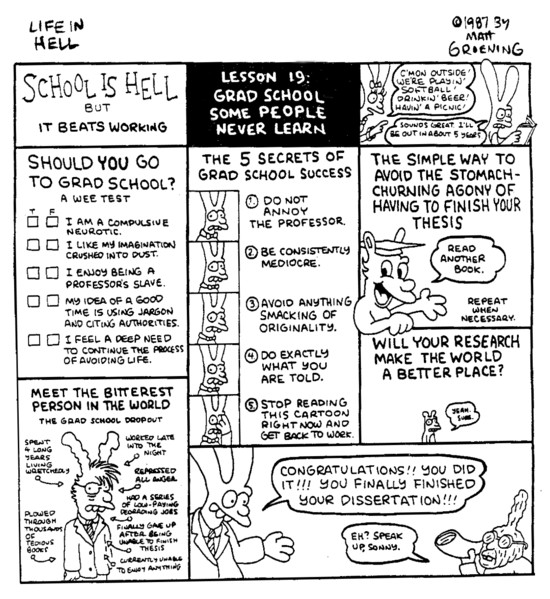
That got a lot of people worked up but for academics, the hot-button article was Rebecca Schuman’s, a visiting assistant professor of German Studies at Ohio State University, piece in Slate, “Thesis Hatement.” She practically begged people not to think of getting a PhD in the humanities, and like an ivory tower Taylor Swift, cautioned them that they will never, ever, ever find anything remotely like a fulfilling, stable, decently paid, benefitted job as an academic and will turn into underemployed, bitter, basket cases. It was the most read and most shared piece on the site for much of the week.
Now, warning people off grad school is not new; just wander over to the Chronicle of Higher Education’s site, where it has been a sort of self-flagellating genre for academics for some time.
But there are some elements to the current woes that are worth mentioning. First, there are some corrections going on in this oversupplied market: graduate programs, especially in the humanities, are shrinking in the US. In part, this has to do with ongoing budget cuts at both state and private institutions as well as a decision on the part of departments to curtail the number of graduates they produce given the abysmal state of the job market. The decline in foreign student applications to graduate programs also seems to be affecting humanities and the softer social sciences.
This is not entirely a bad thing. Even before the current funding crisis, there was a concern about too many marginal graduate programs being created. Eliminating the low quality and borderline programs is not a disservice to either teaching or research. Over time, even though there are fewer good faculty positions, there will be fewer students competing for them so some of the job prospects might improve.
This is probably the only silver lining though. What that doesn’t take into account is the trend, as in so many other areas of the economy, for academic jobs to become low paid and insecure. It is not only that tenure track jobs are declining and adjunct hiring is becoming more common but the rise of the MOOCs also threatens the overall level of employment, with the result, as Andrew Delbanco points out, that research and scholarship in some areas will disappear.
It is not simply that we can’t count on funding from places like state legislatures, but the double whammy of stratospheric levels of student debt and high unemployment among graduates means that that there is little outrage among the public over the cuts and thus little pressure to restore them. Often it seems like quite the opposite. Read any of the hundreds or thousands of online comments generated by articles like Schuman’s or any NYT / WSJ piece on indebted or out of work recent graduates and you find a litany of admonishments like: well, what did you expect with a humanities degree, you should have studied – take your pick – STEM, business, law (unless it’s an article about high unemployment among recent law grads and then you get the same finger wagging), accounting, nursing (ditto the comment about law), etc.
The inability to convince the labor market and the public of the utility of the humanities for offering the kind of critical thinking skills that are so often mentioned as being essential for the future success of the economy has been one of the great failures of the higher education system.
It is not just the humanities’ failure to convince the public but in fact themselves. To read Schuman’s essay is to see the labor market for humanities PhDs as one divided between desirable jobs that include humane teaching loads, support for research, benefits, possibility of tenure and prime (read: coastal cities) location that are so scarce as to be practically mythical and those that force faculty into an existence of cobbling together teaching gigs at multiple institutions that not only don’t pay benefits or offer job security but practically don’t even cover the gas money needed to commute between these multiple jobs.
The answer, she claims, is to not go to grad school. But is it? Certainly, it makes no sense to become wildly indebted to get a graduate degree in the humanities but that’s good advice for most people in most fields. Surely, there is another response. I would argue that schools would do themselves, their students, and the profession a great service by developing robust Plan B options and career services for PhD students.
If a student does not land a great academic job after completing a PhD program, that does not by definition mean the time spent was wasted. After all (again, assuming zero or low levels of indebtedness), there are worse ways to spend a few years post college than being surrounded by smart people, not just talking about ideas you presumably love but pushed to defend them and your arguments about them.
For many though, the problem is that doctoral programs are almost exclusively designed to produce people for academic jobs. When those jobs are in decline, that’s a bad business model.
Those students who as brilliant undergraduates seemed destined to be able to do many great things over time take on the worldview of their departments and professors that the non-academic world is inferior and to work in it a sign of failure. In part, this is why they come to see their only viable options as very undesirable academic jobs when they don’t get that great semi-mythical job.
That the desirability of those ‘inferior’ jobs is subjective is irrelevant, the rewards people look for in jobs are always to some degree subjective. The point is it is not their skill set but their perception of the lack of usefulness and transferability of their own skills to other jobs that would be far more fulfilling than laboring away in the lowest rungs of academia that makes many highly educated people despair. Rather than condemn PhD holders to a life spent hanging on by their fingernails to an academic career, toiling as poorly paid adjuncts or on endless visiting contracts waiting for the perfect job that never materializes, we need to prepare them to translate their considerable skills for a market that is far superior to the one for adjunct faculty.
The time to do this is not once they have failed to secure the tenure track job in their preferred geography. It must be something that universities start from the beginning of graduate programs. I say universities advisedly. Departments are by and large incapable of this. Faculty members typically have social and professional networks composed of other faculty; they are ill equipped to help their students find jobs outside the world of academia when they have not worked there themselves.
University career services, though, usually focus on placing undergraduates or the professional school students (who may even have their own career offices.) For graduate arts and sciences, career advice is mostly left to the departments. This has to change to be more of a partnership so that doctoral students see options beyond professorships. But while it is the universities that have the resources to help graduate students in the non or quasi academic realm, the departments may also need to rethink some of way their programs work and their practices or requirements. This does not have to be at the expense of training the next generation of scholars.
What are some things programs and universities might consider? Here are some suggestions:
- Encourage and assist students to get meaningful work/internship experience in fields where their skills are useful by using the Career Office to link them up with alumni in areas like publishing, market research, university administration, museums, NGO’s, corporate communications, government offices, foundations. Besides exposing students to other options, it will give them connections, references and experience should they ever need to pursue the non-academic track.
- Help graduate students establish their ‘brand’ (which is a reviled concept in most academic circles) and a following by encouraging them to blog, write op-eds, produce online tutorials, contribute to the not purely academic but public intellectual realm such as magazines like n+1.
- Make training in the kind of technologies like GIS and other spatial mapping that have relevance both for the humanities and social sciences, as well as in the business world, either mandatory or a strongly encouraged elective.
The humanities can both help their students and change the skewed public perceptions of their worth by allowing for the kind of training that produces academics and other professionals. It devalues the subject matter and the doctoral students who go through the programs to think they are incapable of anything but a job in the academy and robs the economy of the talent it so desperately needs.
 trishacraig
I myself graduated with a degree in philosophy. After reading I probably wouldn’t survive with such a degree I picked up Psychology (neither pays lol).
Anyway, I find it so ironic when you post what is most important in the world today, you spend great time to write a beautiful piece and no one see’s it.
I understand what you’re saying but truly following any humanities career whatsoever seems faulty, is lonely and concerning because you will not make a good living (financially) unless you establish a business with it. And today finances and economic security are what we come down to. That’s it. It equates to status and class.
Thank you for the post. Much appreciated.