Embracing technology for the early years

Op-ed published in Today, April 22, 2013
By Trisha Craig and Zachary Walker

The Government’s revised kindergarten curriculum is a model for educating the young, with its emphasis on children’s holistic development, learning through play and ensuring that they begin to develop the 21st-century competencies that they will need as Singaporeans and global citizens.

As we prepare today’s learners for tomorrow’s world, it is important to acknowledge that some of the necessary skills include using technology. The curriculum framework notes a role for technology in the kindergarten classroom and that technology should be used in a developmentally appropriate manner and complement — not substitute — concrete activities like art and crafts or outdoor play.

However, the use of technology by young children is a fraught topic. Many view it as a particularly pernicious form of electronic babysitting, turning children into passive consumers of images and say that thus it has no place in educational settings. According to this view, the early childhood classroom is a peaceful haven from a hectic world that is connected 24/7.

However, precisely because technology is such an all-encompassing feature of modernity, to ignore it in educational settings misses the reality of the lives of most children, who are surrounded by it outside of school. Continue reading …

What’s a Humanities PhD to Do?

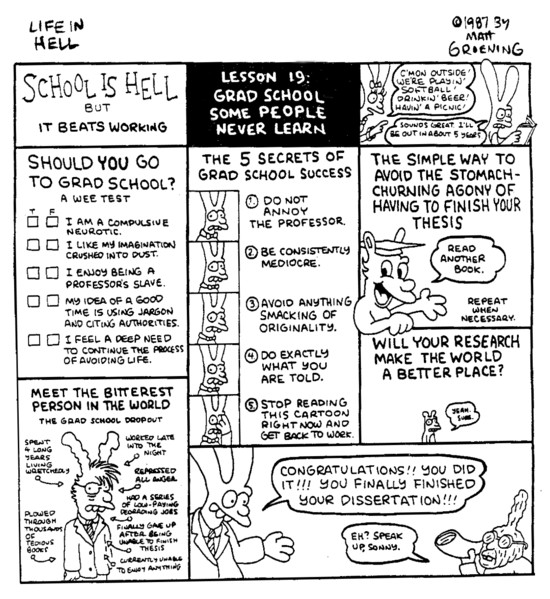
It has been a big week for lamentations and cautionary tales about how making the wrong decision early in your academic career will lead to unrelenting unhappiness and a diminished life.  First, Susan Patton told undergraduate women at Princeton to snag a husband before they graduate or they risked a life of humiliation and despair by potentially ending up with a mate from a no-name school.

That got a lot of people worked up but for academics, the hot-button article was Rebecca Schuman’s, a visiting assistant professor of German Studies at Ohio State University, piece in Slate, “Thesis Hatement.” She practically begged people not to think of getting a PhD in the humanities, and like an ivory tower Taylor Swift, cautioned them that they will never, ever, ever find anything remotely like a fulfilling, stable, decently paid, benefitted job as an academic and will turn into underemployed, bitter, basket cases. It was the most read and most shared piece on the site for much of the week.

Now, warning people off grad school is not new; just wander over to the Chronicle of Higher Education’s site, where it has been a sort of self-flagellating genre for academics for some time.

But there are some elements to the current woes that are worth mentioning.  First, there are some corrections going on in this oversupplied market: graduate programs, especially in the humanities, are shrinking in the US. In part, this has to do with ongoing budget cuts at both state and private institutions as well as a decision on the part of departments to curtail the number of graduates they produce given the abysmal state of the job market.  The decline in foreign student applications to graduate programs also seems to be affecting humanities and the softer social sciences. Continue reading